
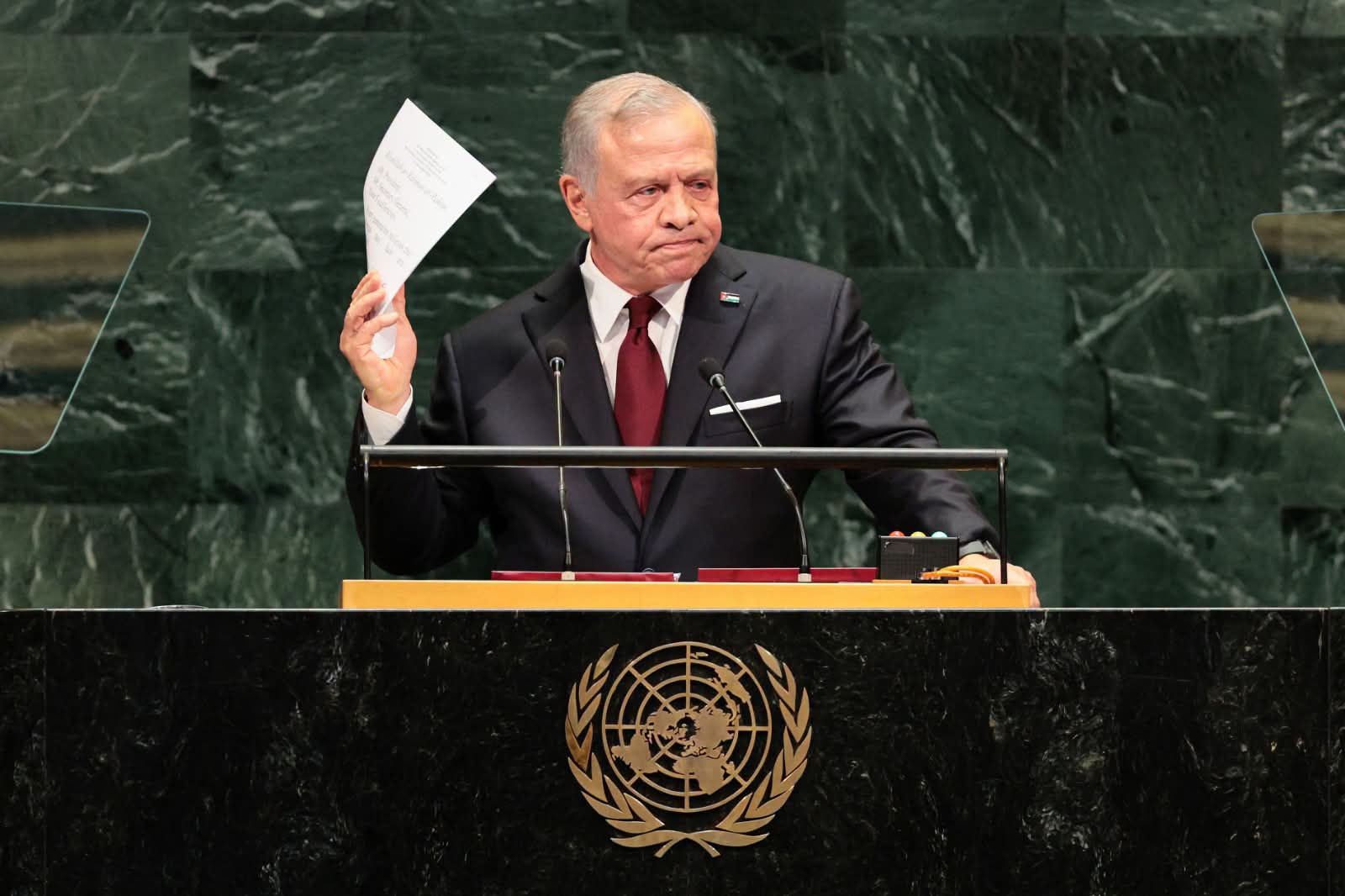
King’s Speech Tops Digital Discussion in Arab and International Circles
Al-Taj News – A study and monitoring and analysis of digital public opinion surrounding His Majesty King Abdullah II’s speech before the United Nations General Assembly in its 81st session showed that the speech received widespread digital engagement during the first 32 hours after it was delivered, with a clear prominence of messages related to the shift in Jordanian political discourse, the Palestinian cause, Gaza, Jerusalem, and the two-state solution.
The analysis showed that the speech generated broad digital resonance during the first 32 hours after it was delivered, reaching approximately 1.2 billion impressions (digital resonance), while global reach was estimated at approximately 744 million users, amid total engagement estimated at approximately 120 million likes, comments, and shares.
Views of video clips related to His Majesty’s speech across TikTok, Instagram, YouTube, and X reached approximately 410 million views.
According to the analysis results, the message “A change in Jordan’s official discourse and a shift in the political tone” topped the list of the most influential messages, with 312 million impressions, estimated reach of 194 million, and 36 million engagements, with a positive sentiment rate exceeding 86 percent.
The message affirming the two-state solution and the establishment of a Palestinian state along the 1967 borders with East Jerusalem as its capital ranked second, with 184 million impressions and reach of 112 million, while the message rejecting the separation of Gaza and the West Bank ranked third, with 142 million impressions and reach of 88 million.
The message on protecting holy sites in Jerusalem ranked fourth, with 98 million impressions and reach of 62 million, while the call for launching an international humanitarian corridor to Gaza ranked fifth, with 52 million impressions and reach of 34 million.
In Jordan, the digital resonance of the speech was estimated at approximately 264 million impressions, an increase of 2,140 percent compared to the baseline for the previous week, while the number of unique authors reached approximately 1.8 million, and the engagement rate stood at 9.8 percent, according to the study.
At the Arab level, the digital resonance of the speech was estimated at approximately 576 million impressions, led by Egypt with 14 percent of the total Arab mentions, followed by Saudi Arabia with 11 percent, Palestine with 9 percent, Algeria with 7 percent, Iraq with 6 percent, Morocco with 5 percent, and Kuwait with 4 percent.
According to the analysis, the message “A change in Jordan’s official discourse and a shift in the tone” topped the list of the most circulated messages in the Arab world, with a reach of 194 million and 26 million engagements, followed by the message supporting the Palestinian people and Gaza, with a reach of 142 million and 18 million engagements, then the two-state solution message, with a reach of 96 million and 12 million engagements.
As for the international discussion, the volume of digital mentions was estimated at approximately 360 million impressions, with a reach of approximately 2026 million according to the figures included in the study, while engagement reached 36 million, and positive sentiment stood at 65 percent, compared with 22 percent neutral sentiment.
The analysis showed that international coverage focused more heavily on messages concerning Gaza and the political solution to the Israeli-Palestinian conflict, with the study citing coverage by international news agencies and media organizations that carried headlines addressing His Majesty the King’s warning against separating Gaza from the West Bank and his emphasis on the two-state solution.
It noted that media coverage presented His Majesty the King as a moderate voice for peace and a key regional ally of the West, with greater focus on humanitarian messages concerning Gaza compared with political messages related to the two-state solution.
At the platform level, X accounted for the largest share of digital resonance at 43 percent, with 510 million impressions and 48 million engagements, while Facebook accounted for 27 percent of the resonance, with 320 million impressions and 38 million engagements; Instagram accounted for 15 percent, with 180 million impressions and 22 million engagements; TikTok accounted for 12 percent, with 145 million views and 9 million engagements; and YouTube accounted for 3 percent, with 45 million views and 3 million engagements.
According to the study, short clips from the speech emerged as some of the most widely circulated materials, with the most prominent being the clip in which His Majesty the King warned against separating Gaza from the West Bank, generating 68 million views and 8.2 million engagements, followed by His Majesty’s quote concerning Jerusalem, which generated 52 million views and 6.4 million engagements.
The analysis also showed that short text quotes achieved wide circulation, led by a quote attributed to His Majesty the King concerning the change in Jordan’s official tone, with a reach of 78 million users, 14 million likes, and 3.8 million reposts, followed by a quote concerning the impossibility of dealing with Gaza and the West Bank as two separate stories, with a reach of 64 million users, 11 million likes, and 2.6 million reposts.
In the same context, the monitoring showed notable Syrian engagement with the speech, as the volume of mentions from Syria was estimated at 86.4 million impressions, with an estimated reach of 52 million users and a positive sentiment rate of 88 percent, while the hashtag “Jordan Tells the Truth” topped the Syrian discussion on X and Facebook during the first hours, according to the study.
The study concluded that the results indicate that the speech generated a broad digital presence at the Jordanian, Arab, and international levels, with differences in engagement priorities across these levels; messages related to the shift in the official tone and defending the Palestinian cause dominated the Jordanian and Arab discussions, while messages concerning the two-state solution and Gaza received greater attention in international coverage.