
Open Clash Between Netanyahu and Ben-Gvir .. Could the Elections Ignite a Split in the Israeli Right?
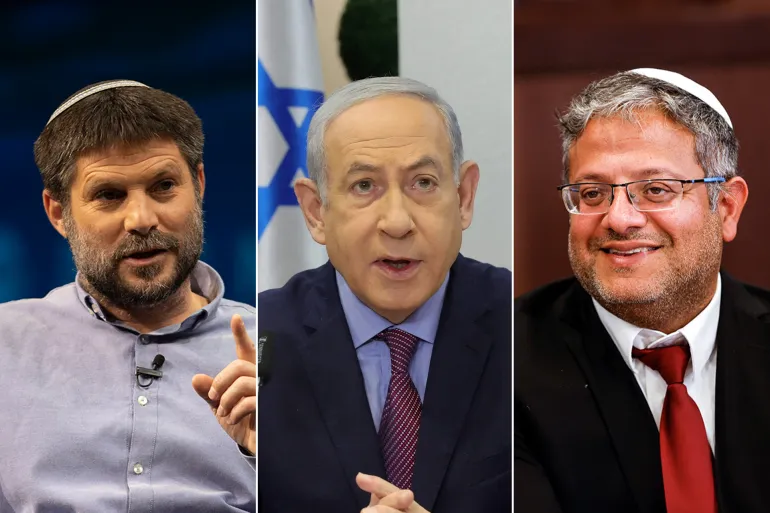
Al-Taj News – The Israeli political scene is witnessing escalating tensions within the right-wing camp over disagreements regarding electoral alliances, following a public exchange between Prime Minister Benjamin Netanyahu and National Security Minister Itamar Ben-Gvir, after Netanyahu called for the next elections to be contested with a unified right-wing list, a call welcomed by Finance Minister Bezalel Smotrich.
In a video clip posted on his account on the X platform on Thursday, Netanyahu called on Ben-Gvir and Smotrich to contest the general Knesset elections scheduled for next October on a unified list, warning that running separately could result in votes from the right-wing camp being lost.
Netanyahu said that Ben-Gvir, head of the “Otzma Yehudit” (Jewish Power) party, and Smotrich, head of the “Religious Zionism” party, “must unite,” citing the 1992 elections, when, according to him, the right had more votes than the left but lost because three parties failed to cross the 3.25% electoral threshold.
He added that the loss of those votes led, in his words, to the “Oslo catastrophe,” the bringing of late Palestinian President Yasser Arafat to Israel, and then Hamas, warning against repeating the same scenario in the upcoming elections.
Netanyahu continued: “Every time we contested the elections together, we won, and every time we contested them separately, we lost.”
In an attempt to contain the dispute between his two allies in the right-wing camp, Netanyahu said he understood that there had been previous “personal” disagreements between Ben-Gvir and Smotrich, calling on them to move past them. He also announced his intention to invite them to a meeting in the coming days to discuss the possibility of contesting the elections on a joint list.
He added: “We will make every effort to unite, and this is what the public expects of them.”
However, Netanyahu’s call was not welcomed by Ben-Gvir, who responded through his X account, rejecting the idea of an alliance with Smotrich and arguing that such a move could weaken his party rather than strengthen the right-wing camp.
Ben-Gvir addressed Netanyahu, saying: “Mr. Prime Minister, I did not understand your video. The attempt to weaken the ‘Otzma Yehudit’ party in order to form a broad national government that includes Eisenkot is neither a right-wing nor a national move.”
He added: “You understand the data and in-depth studies very well, just as I do,” noting that he had discussed the issue with Netanyahu several times in recent weeks.
According to Ben-Gvir, opinion polls indicate that contesting the elections on a joint list with Smotrich would cause the “Otzma Yehudit” party to lose between three and four seats, arguing that these votes “simply will not reach the ballot boxes,” which could, in his assessment, lead to the collapse of the right-wing government.
Ben-Gvir noted that Netanyahu had previously told him that the best scenario for maximizing the number of votes would be for “Wintner” and Smotrich to contest the elections together, saying that Netanyahu believes that “Wintner” does not bring a single vote from undecided voters.
Ben-Gvir concluded his response in an escalatory tone, saying: “The Land of Israel is at stake. The people of Israel are at stake. The State of Israel is at stake.”
He added: “I will do everything in my power to prevent you from forming a government with Eisenkot! There is no alternative to a right-wing government.”
Netanyahu was quick to respond to Ben-Gvir, accusing him of risking the future of the right-wing camp by refusing to ally with Smotrich, while rejecting the accusation that he was seeking to weaken the “Otzma Yehudit” party.
Netanyahu said his goal was exactly the opposite, explaining that “all polls,” according to him, indicate that an electoral alliance between Ben-Gvir and Smotrich would form a strong party that strengthens the right-wing camp and prevents the loss of voters’ votes.
Netanyahu addressed Ben-Gvir, saying: “Smotrich is on the verge of the electoral threshold, and if you do not unite with him, we will get a left-wing government headed by Eisenkot alongside Yair Golan and the Arab parties.”
Netanyahu accused Ben-Gvir of being prepared to risk Israel’s future for “personal ambitions,” calling on him to make what he described as the “right decision,” saying that “the time has come for unity.”
Smotrich, meanwhile, welcomed Netanyahu’s call to unite the right-wing camp in a brief post on X, saying that “the time for unity and responsibility in the national camp” had come.
Smotrich’s position comes at a time when his party, according to opinion polls cited by his opponents and allies, faces the risk of failing to cross the electoral threshold, making the issue of electoral alliances a decisive factor in the calculations of the right-wing camp.
The dispute was not limited to government figures, as Yair Netanyahu, the prime minister’s son, also entered the debate, criticizing Ben-Gvir’s refusal to ally with Smotrich and asking: “How could a technical alliance with Smotrich weaken the ‘Otzma Yehudit’ party? Wouldn’t you gain all of Smotrich’s voters by doing so?”
Yair Netanyahu said opinion polls indicate that the strength of “Otzma Yehudit” would increase through an alliance, warning that Smotrich remaining at the electoral threshold could lead to votes being lost and the collapse of the right-wing camp.
He invoked the 1992 elections, asking whether the right had learned from the experience of the “Tehiya” party and Rabbi Levinger, when votes for parties that failed to cross the electoral threshold weakened the right-wing camp.
Alongside the dispute between right-wing leaders, Israeli reactions were divided over the merits of an alliance between Ben-Gvir and Smotrich.
Some Israeli activists argued that Ben-Gvir should not ally with Smotrich, believing that the interests of the right-wing camp require it to contest the elections independently.
Supporters of this view pointed to the results of previous election rounds, saying that the right-wing camp was at times unable to secure a majority before Ben-Gvir managed to attract segments of voters, contributing to the camp reaching 64 seats.
They added that Ben-Gvir represents, in their view, a different electoral segment from Smotrich, and that running independently could give him an opportunity to attract additional votes, particularly from young people and Mizrahi voters.
Others, however, argued that Netanyahu was right in calling for the two parties to unite, considering that the alliance would prevent voters’ ballots from being wasted if either party failed to cross the electoral threshold.
Supporters of this view said that voters of the two parties would not change their allegiance if a joint list were formed, and that the alliance could also broaden the electoral base of the right-wing camp and attract voters from outside it, at a time when Israeli parties are seeking to redraw their alliances in preparation for the upcoming elections.
The general elections are scheduled to be held on October 27, and are considered crucial to Netanyahu’s political future, as he faces accusations of corruption, authoritarianism, and failure.