
Stones Thrown at Jordanian Trucks .. Who Is Fueling the “Back-to-Back” Crisis on the Syrian Border?
Al-Taj News – Daifallah Abu Aqoula, Captain of the Jordanian Association of Clearance and Cargo Transport Companies, confirmed that the protests carried out by a number of truck drivers at the Jordanian-Syrian border came in objection to the exemptions granted to certain materials from the “back-to-back” system, stressing that neither the Jordanian truck nor the Jordanian driver has anything to do with decisions to allow or prevent trucks from entering Syrian territory.
Abu Aqoula said that the General Authority for Customs Ports in Syria issued Decision No. (31) last February, which stipulates preventing non-Syrian trucks from entering Syrian territory and adopting the “back-to-back” system at border crossings.
He explained that implementing the decision faced challenges in transporting some materials that are difficult to unload and reload onto Syrian trucks, which led to exemptions being granted for specific loads, including clinker, bulk cement, cranes, marble blocks, and glass, and allowing them to enter Syria without applying the “back-to-back” system at the Nassib Customs.
He noted that some drivers protest from time to time to demand the cancellation of these exemptions and the transportation of all goods on Syrian trucks, but the equipment available on the Syrian side does not allow for the transportation of certain types of cargo.
Abu Aqoula stressed that “the Jordanian truck and the Jordanian driver are not at fault for preventing or allowing their trucks to enter Syrian territory,” explaining that these decisions are issued by the Syrian government, which is the authority authorized to allow certain materials to enter without transferring them between trucks.
He called on the government, Syrian authorities, and the joint Jordanian-Syrian technical committees, in the event that these materials are allowed to enter, to protect the Jordanian driver, emphasizing that the driver has nothing to do with the exemptions granted.
Stone Attacks on Jordanian Trucks
Abu Aqoula revealed that a limited number of drivers filmed moments when Jordanian trucks loaded with cement and clinker were pelted with stones and published the footage documenting the attacks, calling on the Syrian authorities to pursue the attackers and hold them accountable.
He confirmed that the circulating footage is genuine and was filmed by drivers who were subjected to the attacks, stressing that Jordanian drivers transport goods at the request of traders and that the export of cement to Syria takes place with the approval of the Syrian authorities. Therefore, “they must not be attacked or harmed.”
Abu Aqoula stressed that these incidents do not disturb the strong Jordanian-Syrian relations, pointing to the scale of trade cooperation and the movement of goods between the two countries, particularly through the Jaber crossing toward the Gulf states and the Port of Aqaba.
He added that the Jordanian Truck Owners Association, represented by its captain, Mohammad Khair Al-Daoud, contacted the relevant authorities to intervene, prevent the attacks from recurring, and pursue those responsible.
He explained that there is joint coordination between the Jordanian Association of Clearance Companies and the Truck Owners Association to organize truck manifests, unload them, and follow up on them, in addition to ongoing meetings and communications with security agencies, the Land Transport Regulatory Commission, and the Ministry of Transport, with the aim of coordinating with the Syrian side and ensuring that attacks on Jordanian drivers do not recur.
Growth in Cross-Border Transport Activity
Abu Aqoula pointed out that work activity at the Jordanian-Syrian border is witnessing notable growth, noting that the number of customs declarations has currently risen to more than 17,000 and 18,000, compared with the same period last year.
He denied the existence of a general threat to Jordanian drivers inside Syria, considering the attacks that occurred to be “individual acts by people who are outside the law,” and calling on the Syrian authorities to take the necessary measures against those responsible.
He confirmed that hundreds of Jordanian trucks enter Syrian territory daily, travel normally, and unload their cargo, while such attacks by a limited number of individuals recur every month or month and a half. He stressed that they “do not represent the Syrian people or government” and that a deterrent must be put in place to end such behavior.
Protests Over the “Connection System”
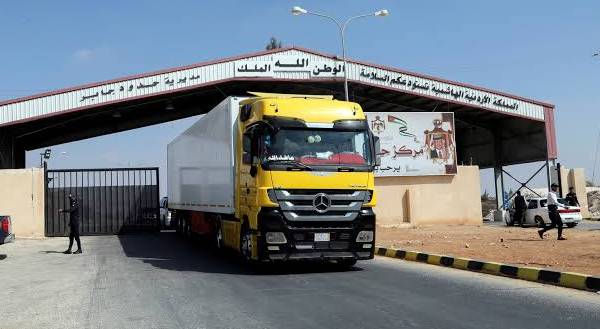
These developments come amid escalating protests by truck drivers at the Jaber-Nassib border crossing over the continued use of the “special connection system.”
Drivers and transporters called on the Ministry of Transport to intervene urgently to cancel the mechanism and adopt a fair turn-taking system that ensures equality among all transporters, considering that the issue has gone beyond being merely regulatory procedures at the border and has begun to affect the interests of the transport sector and the livelihoods of thousands of Jordanians as a result of limiting the ability of Jordanian trucks to enter Syrian territory.
The protests witnessed tension and attacks on a number of Jordanian trucks, as protesters pelted trucks with stones, resulting in the shattering of the glass of one Jordanian dump truck and causing material damage to it, according to drivers’ accounts. Al-Mamlaka