
U.S. Strikes Target Iranian Sites to Prevent Mine Deployment in Strait of Hormuz
Al-Taj News – Against the backdrop of U.S. President Donald Trump’s threats to strike Iran forcefully, U.S. airstrikes targeted two Iranian missile-launching sites late Monday, which the U.S. military said were capable of launching small naval mines.
Captain Tim Hawkins, spokesperson for the U.S. Central Command (CENTCOM), which oversees U.S. military operations in the Middle East, said that U.S. forces had detected Iranian Revolutionary Guard forces preparing to launch missiles loaded with naval mines toward the Strait of Hormuz.
Unusual Weapon
These developments have raised questions, as this type of weapon, consisting of artillery rockets that launch mines into the water, is relatively unusual and could indicate that Tehran is developing a potential new means of causing disruptions in the Strait of Hormuz.
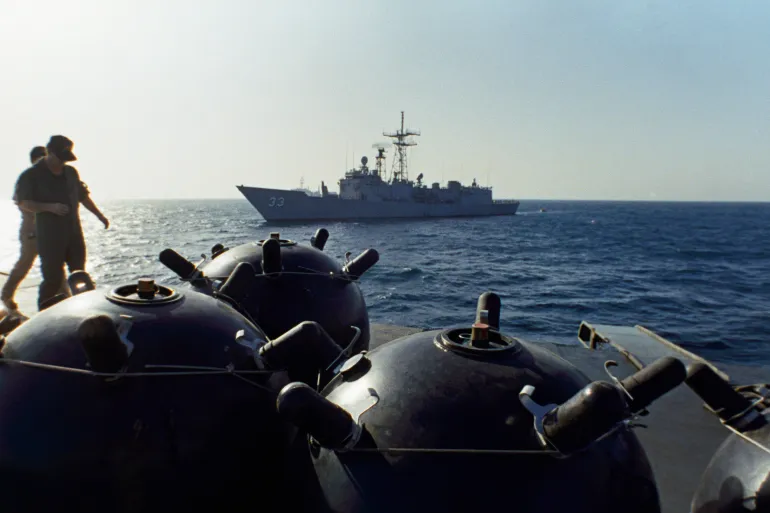
Iran is known to possess a diverse arsenal of naval mines, ranging from small limpet mines attached by divers to the hulls of ships, to larger mines deployed by boats or ships that can cause maritime targets to sink.
However, publicly available information about mines launched from land by rockets remains extremely limited, according to what The New York Times reported.
This could mean that Tehran has added a new type of mine to its arsenal, although it is likely to have limited destructive power.
Fajr-5 Missile
The Maritime Executive, which specializes in shipping and maritime industry news, reported in January 2025 that Iran had showcased during naval exercises a modified version of the Fajr-5 missile capable of launching a single floating naval mine into the water.
Nevertheless, this type of weapon is unlikely to cause serious damage to commercial cargo ships in the region, as many tankers have double hulls designed to withstand punctures and damage without leaking their oil cargo.
However, these mines could pose a greater danger to small fishing boats operating in the Arabian Gulf.
The Fajr-5 missile is believed to be capable of carrying a mine no more than 333 millimeters in diameter, which is the same diameter as the missile itself, and contains only dozens of pounds of explosives.
By comparison, the most dangerous naval mines contain hundreds of pounds of explosives and are fixed in position to float just below the water’s surface or settle on the seabed.
As for the small mines referred to by U.S. Central Command, they would likely cause a limited puncture in the hull of a warship and lead to water leaking into a single sealed compartment inside the vessel.
These munitions, known as “drifting mines,” begin drifting under the influence of wind and sea currents as soon as they fall into the water.
Over time, these mines may reach the open ocean or drift toward shore, where they could pose a danger to anyone who finds and picks them up.
It is recalled that last March, U.S. intelligence officials reported that Iran had planted a number of mines in the strait.
However, the U.S. president announced in a social media post on August 25 that all naval mines in the strait had been removed from “international waters,” likely referring to the traditional shipping lane used by commercial vessels for decades under international law.
The United States confirmed yesterday that its attacks on Lark Island were aimed at preventing Iran from deploying more naval mines in the strait, days after announcing that it had cleared it of mines.
These developments on the ground came as the war between Iran and the United States entered its seventh month, since the first U.S.-Israeli strikes on Tehran on February 28, after a month of military calm, amid diplomatic efforts led by mediators, foremost among them Pakistan and Qatar, over several months to end the war, with no result so far.
Despite the announcement of a ceasefire in April and the signing of a memorandum of understanding in June in preparation for establishing a final peace, no agreement has been reached, and Washington has since declared an “economic war” on Tehran.
The United States has continued its naval blockade, which has prevented fuel supplies from reaching Iran, which is already suffering from a shortage in domestic production.