
Amman Traffic Jams Choke Roads .. A 10-Minute Journey Stretches to an Hour and a Half
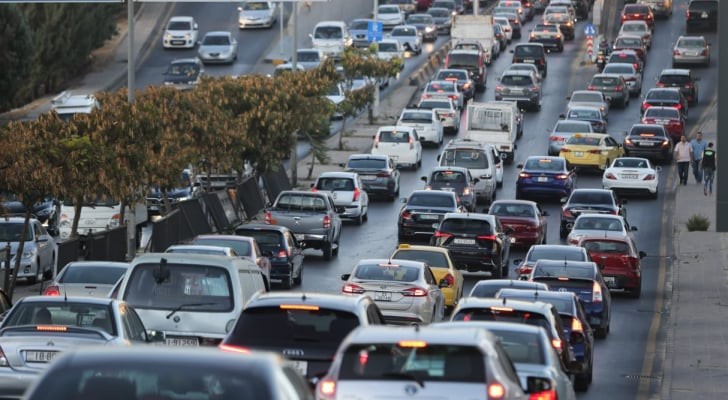
Al-Taj News – A journey inside the capital that used to take 10 or 15 minutes now stretches to an hour, and in some cases perhaps an hour and a half, according to estimates by urban planning experts. Meanwhile, the city is facing pressure from more than 1.5 million vehicles within its boundaries, in addition to the daily influx from the governorates and vehicles belonging to expatriates and visitors during the summer and holiday seasons.
The figures and official responses present Amman’s traffic crisis as a complex picture; congestion is not solely the result of the rising number of cars, but rather the outcome of the interaction between population growth, urban expansion, and the distribution of economic activities, coupled with public transportation lagging behind the city’s expansion, large parts of the roads’ capacity remaining unchanged, as well as parking and traffic behaviors within the streets.
While official authorities are moving toward expanding mass transportation, improving entrances and intersections, and introducing smart systems to manage traffic, specialists believe that a sustainable solution begins with linking land use to transportation, building feeder networks that connect neighborhoods to public transportation corridors, and managing demand for private vehicles, rather than merely adding lanes or constructing new intersections.
Traffic Pressure Extends Beyond the City’s Boundaries
The Director of the Traffic Operations Department at the Greater Amman Municipality, engineer Shadi Al-Rawashdeh, attributed congestion to interconnected factors, foremost among them population growth, urban expansion, and the capital’s economic, tourism, and service status, making it a destination for work, education, services, and settlement.
According to Al-Rawashdeh, Amman has more than 4.5 million residents and accounts for about 70% of the total vehicles registered in the Kingdom, while the number of vehicles in the capital exceeds 1.5 million, excluding vehicles arriving daily from the governorates and those entering during the seasons when expatriates return and during holidays.
The Ministry of Public Works and Housing estimated, in response to questions from “Al-Ghad,” through its media spokesperson Omar Al-Maharmah, that the number of vehicles flowing into the capital daily through more than five of the most congested entrances is approximately 200,000 vehicles during the morning and evening peak periods. However, the response did not include a breakdown of this figure across the five entrances or details of the methodology used to calculate it.
According to Al-Maharmah, the Amman-Zarqa corridor records more than 120,000 vehicles daily in both directions, while approximately 75,000 vehicles travel along the Amman-Salt corridor at Sweileh. Traffic volume on Airport Road exceeds 190,000 vehicles in both directions, including traffic coming from Madaba, the southern governorates, and the airport. The ministry also estimates the annual increase in the Kingdom’s vehicle fleet at approximately 80,000 new vehicles, gradually increasing pressure on the main entrances and corridors.
Urban planning and development expert and head of the Planning and Urban Design Committee at the Jordan Engineers Association, consultant Dr. Khaled Al-Momani, points out that the number of vehicles registered in the Kingdom has exceeded 2.4 million and may rise in the summer to more than 2.7 million with the vehicles of expatriates and visitors.
A Planning Crisis Before It Is a Roads Crisis
Al-Momani believes that the roots of the problem extend back decades of urban planning that treated public transportation “as a deferred add-on, not the backbone of the city.” Amman expanded horizontally at a faster pace than the development of road and transportation networks, while new areas grew away from public transportation corridors, turning the private car from an option into a daily necessity for a wide segment of the population.
He adds that the concentration of malls, towers, and major commercial activities along main corridors, without adequate traffic impact studies, has increased demand on roads with limited capacity. The problem is not limited to major establishments; parking in front of a shop or bakery may close an entire lane and turn the street into a bottleneck, particularly in the absence of parking spaces and effective enforcement.
Engineer Mazen Al-Nabulsi, Secretary of the Architectural Engineering Division at the Jordan Engineers Association and a specialist in urban design, agrees with the diagnosis of the planning flaw, considering the crisis to be the result of a lack of continuous planning and a relative deficiency in comprehensive planning. He says the city’s plan should not remain static, but should be reassessed every 10 or 15 years to include land use, traffic movement, roads, activities, and green areas.
Al-Nabulsi identifies other causes, including weak gradation between main, collector, and residential roads, the inadequacy of some road designs for future growth requirements, and the high concentration of activities in areas that exceed their carrying capacity. He believes that repeatedly relying on roundabouts and traffic signals does not provide a permanent solution if it is not preceded by an understanding of the nature of the street, its uses, and the volume of traffic on it.
For his part, Wafai Amsis, head of the Jordanian Society for the Prevention of Road Accidents, says congestion begins when traffic volume exceeds road capacity, causing speeds to decline until traffic comes to a standstill and becomes gridlocked. He links the crisis to the rising number of vehicles, the unchanged space available on streets, in tunnels, and on bridges, and the weak coverage of neighborhoods by public transportation, in addition to the spread of taxis and ride-hailing vehicles during peak hours while searching for passengers, as well as parking problems in front of establishments.
Amsis believes that allocating parts of some streets to Bus Rapid Transit lanes has increased pressure on vehicle movement, but at the same time stresses that the core of the problem lies in the absence of an extensive public transportation network that provides citizens with a practical alternative to their private cars.
The Greater Amman Municipality deals with congestion on three levels, according to Al-Rawashdeh. The operational level begins with continuous monitoring through the joint control room with the Traffic Department, monitoring intersections and traffic signals, and taking measures to ease bottlenecks. The engineering level includes traffic studies, reorganizing lanes, converting some roundabouts into traffic signals, and implementing bridges and tunnels based on traffic and accident data. The strategic level focuses on developing public transportation, infrastructure, and intelligent transportation systems.
In response to “Al-Ghad’s” questions, the Greater Amman Municipality said that smart traffic signals adjust their timings based on traffic volumes, while the control center monitors the main corridors to reduce response times. It revealed that it expects to operate a system for predicting congestion at the beginning of next October, meaning that current management relies primarily on monitoring and response before moving to advance prediction.
This detail highlights the difference between the current situation and the upcoming plan. Amsis said that artificial intelligence is currently being used to regulate violations, not to predict congestion, while the municipality is speaking of an anticipated prediction system. Its effectiveness will depend on the accuracy of the data, how far in advance it can predict congestion, and its ability to turn alerts into changes in traffic signal timings, traffic direction, or incident management.
As for the Ministry of Public Works, it confirmed that it does not have a system for monitoring and predicting congestion, and that it deals with traffic flows at arterial entrances from the perspective of planning network capacity and accommodating vehicles. The ministry coordinates with the Greater Amman Municipality, the Traffic Department, the External Patrols Department, and the Ministry of Transport regarding accidents, closures, diversions, the removal of obstacles, and the dissemination of warnings.
The Ministry of Public Works says it has completed the Amman-Zarqa entrance project from Al-Mahatta Complex to the New Zarqa Complex, with a length of 20 kilometers and an estimated cost of 160 million dinars. The works included expanding the road to between three and five lanes, constructing 11 bridge and tunnel intersections, four median stations and one main station, and separating the Bus Rapid Transit lane from vehicle traffic.
The improvements associated with the project included the intersections of Al-Mahatta, the slaughterhouse, Ain Ghazal, Marka, Al-Hizam, Al-Zaytouna, and the Military College, reaching the main Zarqa intersection, with the aim of eliminating bottleneck points and increasing capacity at one of the capital’s busiest entrances.
The ministry also carried out improvements to Airport Road, according to Al-Maharmah, at an estimated cost of 350,000 dinars. These included separating the service road, repairing damaged sections, rehabilitating the median, and improving entrances and traffic directions. The cost of improvements to the Amman-Salt entrance amounted to 1.52 million dinars and included organizing medians, expanding the road, constructing a service road, maintaining asphalt mixtures, and installing a pedestrian bridge. Meanwhile, work on the eastern Amman-Madaba entrance amounted to 4.65 million dinars and included improving entrances and exits, maintaining the road, organizing medians, and strengthening safety measures.