

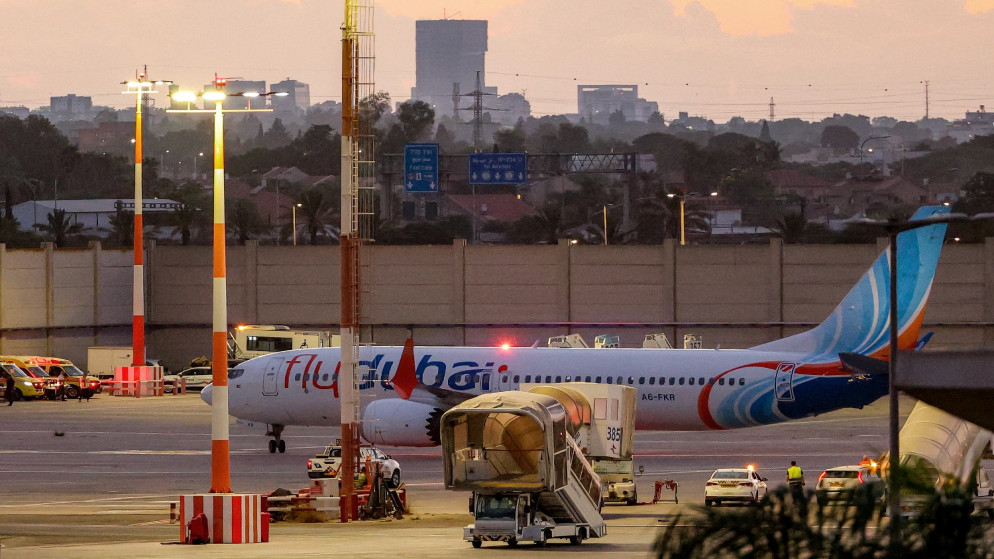
Despite Its Proximity to Jordan.. Why Did Flydubai Choose to Make an Emergency Landing in Tabuk?
Al-Taj News –
Ghada Al-Khouli
A Flydubai aircraft heading to Tel Aviv, carrying 174 passengers, was forced to make an emergency landing at Tabuk Regional Airport in the Kingdom of Saudi Arabia, despite its geographical proximity to Jordan, particularly as the aircraft’s route briefly entered Jordanian airspace before turning back toward Saudi Arabia, according to flight-tracking data.
Regarding the reasons for this, retired Brigadier General Staff Ayman Al-Rousan, a military expert, explained that the choice of an airport in cases of emergency landings does not necessarily depend on the “closest” criterion. Rather, it is subject to precise standards and protocols related to aviation safety, landing procedures, and air traffic guidance, in coordination between the aircraft captain, the control tower, and the relevant authorities.
Al-Rousan explained in an interview with “Al-Taj News” today, Thursday, that the airport that may be the most practically suitable may not be the geographically closest one. Factors taken into consideration include the nature of the situation, the aircraft’s route, approach and landing procedures, air traffic guidance, and the airport’s speed and ability to receive the aircraft under emergency conditions.
He added that attempting to link the aircraft’s landing in Saudi Arabia to political relations with Israel does not, in itself, constitute an indication of this, considering that receiving the aircraft under such circumstances is a natural and humanitarian procedure required by aviation safety and civil aviation regulations.
He stressed that, had the aircraft headed to one of Jordan’s airports, Jordan “would not have refused to receive it,” noting that dealing with such cases is “an ethical and humanitarian matter” before being a political one.
In this context, the expert addressed the incident from a security and military perspective, noting that what took place inside the cockpit, according to circulating accounts, involved an altercation between the aircraft captain and his first officer, followed by a sharp descent of the aircraft and the use of emergency codes, including code 7700, while some accounts indicated that code 7500, associated with a hijacking situation, had been used.
He pointed out that some of the details circulating about the incident still need to be verified through the black box data, cockpit recordings, and the crew’s communications with air traffic control, as these are the decisive sources for accurately determining what happened.
He noted that the incident quickly moved beyond the technical aspect into political and media dimensions, with Israeli accounts and analyses emerging that linked the incident to security or terrorist possibilities, while some analyses went as far as comparing it to scenarios involving previous attacks. He stressed that such characterizations remain within the realm of hypotheses until the official investigation results are issued.
He also pointed out that the Israeli handling of the incident, according to circulating accounts, reflected the level of concern over the possibility of a security threat, amid reports of military preparations to deal with the aircraft. He stressed that any conclusion regarding deliberate intervention or a terrorist act cannot be determined solely from the landing location or the nature of the security measures.
He stressed the need to distinguish between the incident itself, its security interpretation, and then its political, media, and military exploitation, emphasizing that the final judgment on the circumstances of the incident must be based on evidence and recorded data, rather than competing narratives.
Al-Rousan noted that, regardless of the investigation’s findings, the incident may prompt a future review of cockpit security procedures and mechanisms for assessing the security of aircraft crews in emergency situations.