
Astronomical Society: Partial Lunar Eclipse Observed in Jordan’s Skies Early Friday
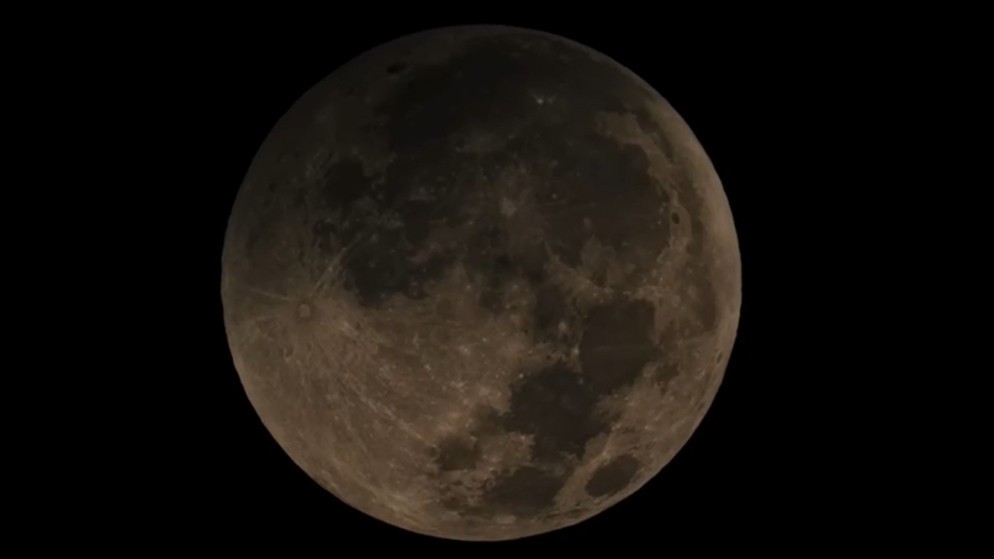
Al-Taj News – Jordan’s skies witnessed a deep partial lunar eclipse early Friday, as observation teams and enthusiasts were able to follow the stages visible from the Kingdom before the Moon set on the western horizon, according to Ammar Al-Sakji, president of the Jordanian Astronomical Society.
Al-Sakji said in a statement that astronomical observation began from northern Amman at 4:10 a.m. and continued until approximately 5:50 a.m. The phenomenon was also documented using time-lapse photography by capturing around 6,000 frames, which showed the eclipse gradually developing.
He explained that the Moon entered Earth’s penumbral region at around 4:24 a.m., when its brightness began to gradually fade. The partial eclipse phase then began at 5:33 a.m., as part of the Moon’s disk entered Earth’s dark shadow.
He confirmed that the observed stages and their timings were in good agreement with the astronomical calculations carried out by the Jordanian Astronomical Society weeks before the eclipse occurred.
Various observation methods were used to document the phenomenon, including telescopes, cameras, binoculars, and the naked eye, in addition to time-lapse photography, which made it possible to record the Moon’s movement and the development of the eclipse over approximately one hour and 40 minutes.
He noted that the eclipse was a deep partial eclipse, with the portion of the Moon’s disk covered by Earth’s shadow reaching 96.2% at the global maximum. However, this maximum was not visible from Jordan because the Moon had set before the eclipse reached it. As the eclipse progressed, the Moon gradually descended toward the western horizon, coinciding with increasing morning twilight.
He pointed out that Friday’s eclipse belonged to Saros Series 138 and was the 29th of 82 eclipses in this series. The observation early Friday provided an opportunity to document one of the most prominent astronomical phenomena visible from the Kingdom’s skies this year and to make a direct comparison between the prior astronomical calculations and the actual observation of the phenomenon.