

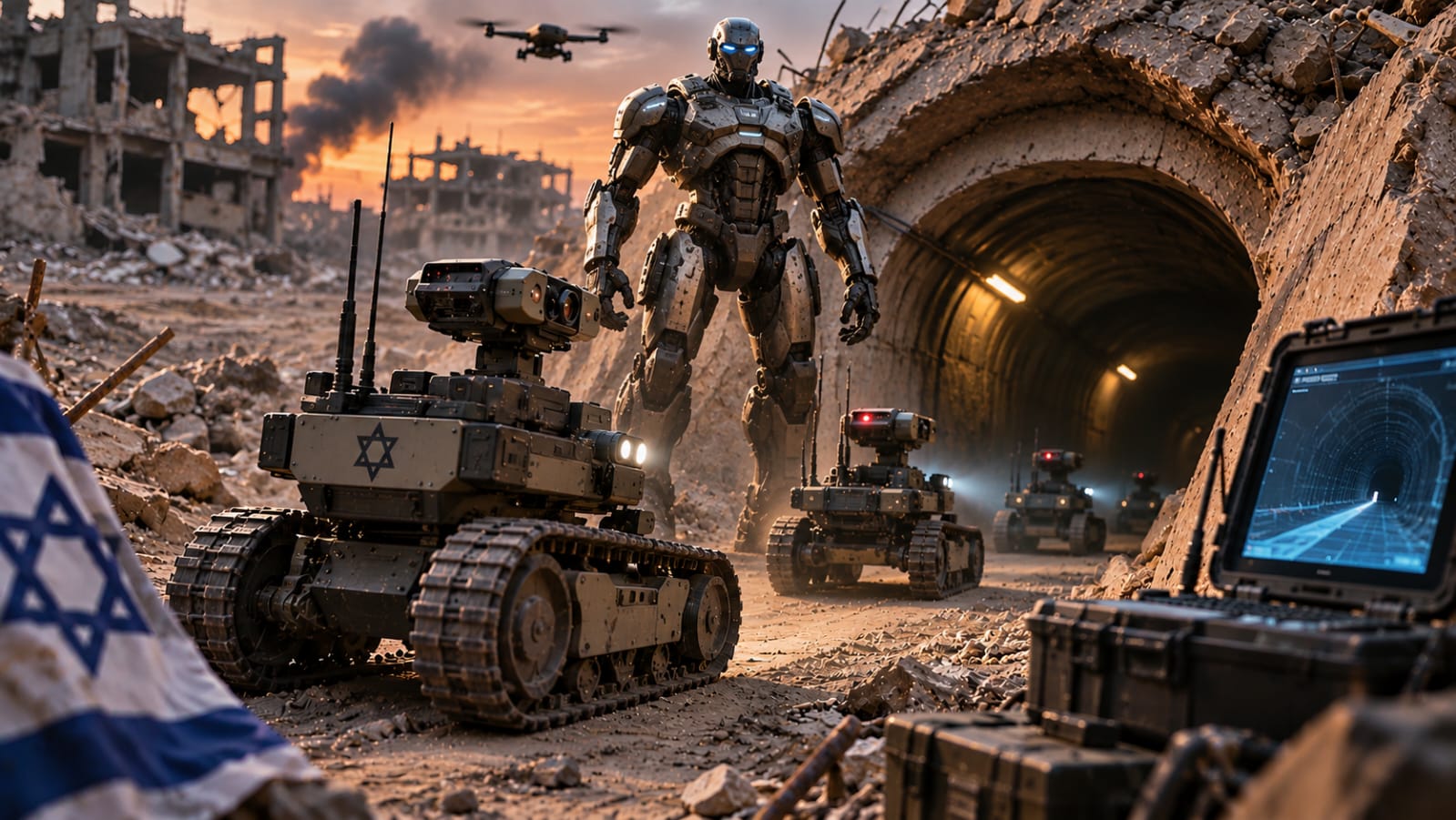
Robots Detect Targets and Open Fire Without Human Intervention .. What Is Israel Planning for Gaza’s Tunnels?
Al-Taj News –
Haneen Zubaida.
Robots Fighting Without Human Orders .. Could Gaza’s Tunnels Become a Testing Ground for the Wars of the Future?
Military expert and Israeli affairs specialist Dhaifallah Al-Daboubi predicted that the coming years will witness a major expansion in reliance on robots and autonomous weapons during military operations, amid armies’ move toward reducing dependence on human personnel and lowering human casualties. He expects their uses to extend to military operations, border surveillance, and confronting infiltration and smuggling operations.
“The Place You Send a Bullet To, You Do Not Send a Soldier To” .. Israel’s Doctrine in the Tunnels
In remarks to Al-Taj News, Al-Daboubi said that Israel’s move toward introducing combat robots into Gaza’s tunnels is linked to its long-standing military strategy, based on the principle: “The place you can send a bullet to, do not send a soldier to,” referring to its pursuit of reducing casualties among its soldiers and reaching its objectives without exposing them to danger.
He explained that the tunnels in Gaza are extensive and interconnected, containing multiple winding passageways, which makes the entry of Israeli soldiers into them fraught with risks, particularly since a number of them were booby-trapped, while fighters were present inside, waiting for Israeli forces to advance so they could detonate the tunnels or open fire on them. This prompted Israel to seek alternative means of carrying out missions inside these tunnels.
He noted that autonomous robots, according to this approach, represent a means of carrying out military missions without the need to send soldiers into dangerous areas. He pointed out that these systems may be capable of identifying targets, assessing them, opening fire on them, and destroying them without direct human intervention.
Centralized Planning and Autonomous Execution .. How Do Combat Robots Work?
Al-Daboubi noted in his remarks to Al-Taj that this type of weapon is associated with what he described as the theory of “centralized planning and decentralized execution.” Under this approach, orders and missions are set in advance, and then the robots are deployed to carry them out autonomously, enabling them to identify the locations and directions of targets inside tunnels, whether to the right, left, or ahead, without waiting for direct human orders to open fire.
From Tunnels to Civilian Life .. Repercussions Beyond the Military Battlefield
Regarding the implications of using these robots for the nature of combat and the lives of residents, Al-Daboubi affirmed that they will have an impact on both the military and civilian levels, particularly as they reach advanced levels of intelligence and autonomous operation.
He added that the danger of these systems is not limited to military operations inside tunnels, but also extends to citizens located near them or inside them. He warned that the continued presence of these robots without an end to the war in Gaza could cause their impact to extend to civilian and military life in the future.
Autonomous Weapons .. Could They Fall Outside International Oversight Rules?
Regarding the postponement of resolving the international rules governing autonomous weapons, Al-Daboubi said that these weapons are not considered internationally prohibited weapons, unlike chemical, biological, and nuclear weapons. He considered them to fall within the category of military means and technologies that include drones, robots, autonomous ground vehicles, and autonomous naval vessels.
He explained that the concept of autonomous operation means a weapon’s ability to move, search for targets, detect and identify them, and proceed to open fire and assess the damage resulting from targeting, without human intervention at the stages of carrying out the mission.
He pointed out that these systems differ from the drones currently in use, which can be pre-programmed to bomb specific targets according to certain coordinates through the Global Positioning System (GPS), or directed through orders issued by ground surveillance units and radars. He noted that autonomous weapons go beyond this to searching for targets, identifying them, and independently deciding to target them.
During his remarks to Al-Taj, Al-Daboubi ruled out the possibility of the United Nations having an influential role in this field, considering that autonomous weapons, from his point of view, do not differ from conventional military operations and do not fall within the category of internationally prohibited weapons.
From Battlefields to Borders .. Robots Are Shaping the Future of Wars
Regarding the scenarios expected in the coming years, Al-Daboubi predicted that robots would move from supporting uses to widespread reliance on them in military operations, as well as in smuggling, border crossing, infiltration, and illegal entry operations, whether through land, air, or sea systems.
He stressed that the coming race will be directed toward reducing reliance on human manpower in military operations and replacing it with automated systems, metals, artificial intelligence, and technology to carry out missions, destroy targets, and protect borders and military areas.
Al-Daboubi concluded his remarks to Al-Taj by pointing out that the world is moving toward developing weapons that are not internationally prohibited and are capable of independently carrying out the missions assigned to them, while reducing human casualties as much as possible.