
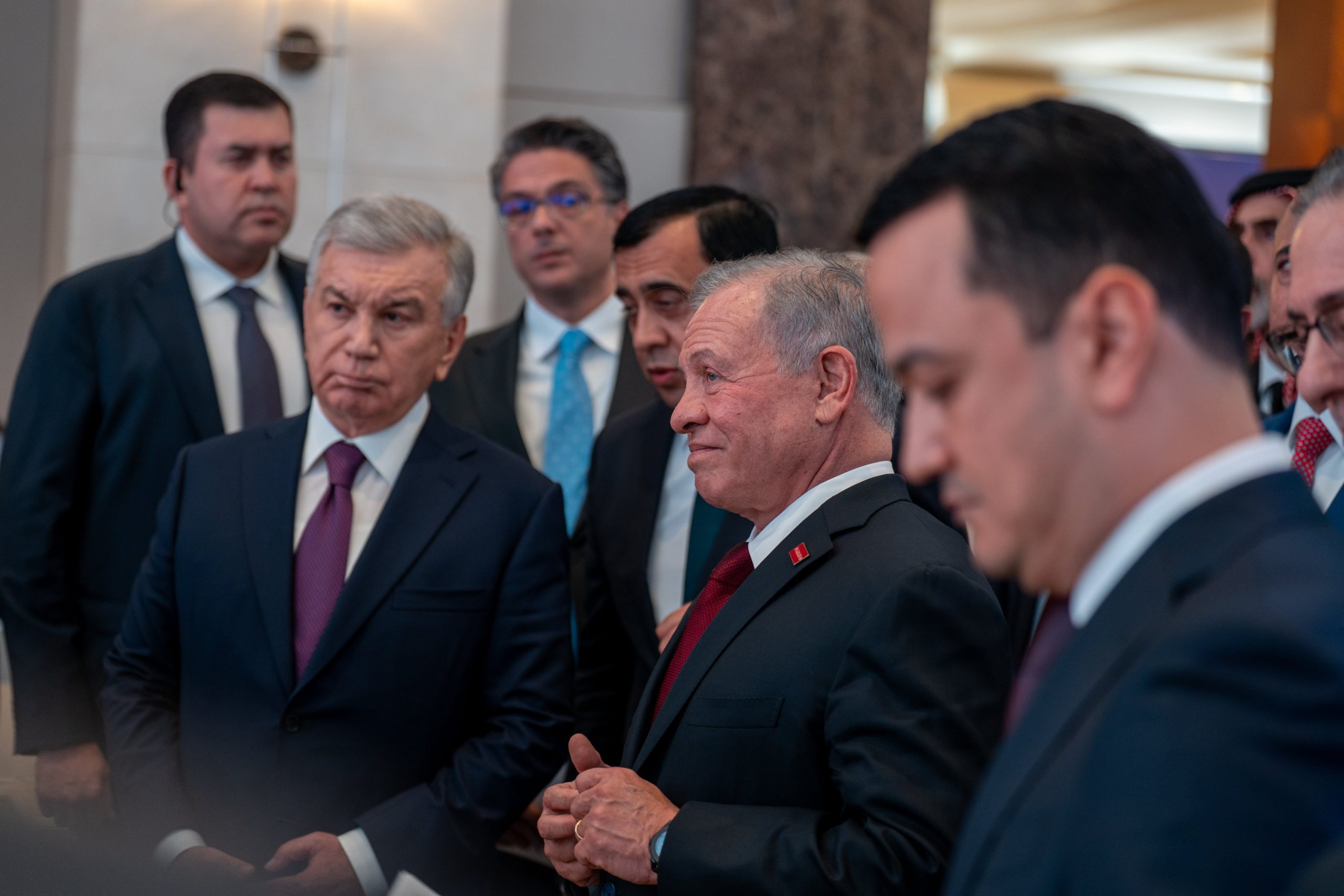
Jordan and Uzbekistan Issue Joint Statement at Conclusion of Talks Between the King and Uzbek President
Al-Taj News – The Hashemite Kingdom of Jordan and the Republic of Uzbekistan issued a joint statement today, Tuesday, at the conclusion of talks between His Majesty King Abdullah II and President Shavkat Mirziyoyev, which were held in Amman.
The following is its text:
“Joint Statement between the Hashemite Kingdom of Jordan and the Republic of Uzbekistan on Strengthening Bilateral Relations and Cooperation
At the invitation of His Majesty King Abdullah II ibn Al Hussein, His Excellency President Shavkat Mirziyoyev, President of the Republic of Uzbekistan, paid a state visit to the Hashemite Kingdom of Jordan on November 23–24, 2026. During the visit, His Majesty King Abdullah II and His Excellency President Shavkat Mirziyoyev held fruitful talks on ways to strengthen the established relations of friendship and cooperation between the two countries and peoples, and exchanged views on regional and international developments and issues of mutual interest.
The two leaders affirmed the depth of the bonds of friendship based on mutual respect, trust, and shared interests between Jordan and Uzbekistan. They agreed to elevate relations between the two countries to the level of a strategic partnership, with the aim of enhancing comprehensive and multi-sectoral cooperation.
The two sides welcomed the progress made in implementing the outcomes of the state visit paid by His Majesty the King to Uzbekistan in August 2025, including the holding of the first session of the Jordanian-Uzbek Joint Governmental Commission in April 2026, the operation of direct flights between Amman and Tashkent, the exchange of high-level visits in numerous fields, and the implementation of the mutual visa exemption arrangement. The two sides stressed the importance of maintaining this positive momentum, ensuring effective follow-up, and implementing the agreements reached between the two countries.
The two leaders expressed their commitment to expanding the scope of economic, trade, and investment cooperation, and encouraging the establishment of stronger partnerships between the public and private sectors in the two countries. They identified the pharmaceutical industries, healthcare, agriculture, fertilizers, food security, energy, mining, water, industry, textiles, information and communications technology, culture and religious affairs, digitalization, logistics, tourism, scientific research, youth, education, and other promising sectors as areas with significant potential for expanding cooperation.
The two leaders witnessed the signing of a number of agreements and memoranda of understanding in key areas of bilateral cooperation, including strategic partnership, twinning between cities, pharmaceutical industries, health, preferential trade, energy, mineral resources, water management, legal assistance, urban development, environmental protection, culture, digitalization, and information technology. They affirmed that the two countries would work systematically to expand cooperation to include other promising sectors of mutual interest.
The two sides expressed their commitment to strengthening trade relations through the gradual reduction or elimination of customs duties and para-tariff fees on specific goods, diversifying traded products, and facilitating the integration of companies, particularly small and medium-sized enterprises, into regional and global value chains. They also affirmed the importance of promoting trade, encouraging fair competition, consolidating economic cooperation, and removing trade barriers, in line with the objectives of the multilateral trading system and the expansion of global trade.
The two leaders exchanged views on regional and international developments of mutual interest and expressed their deep concern over the continued escalation in the region and its repercussions for peace and security at the regional and international levels. They stressed the need to de-escalate tensions and exert intensive regional and international efforts to resolve regional crises through diplomatic solutions that restore security and stability and address all causes of tension, on the basis of international law, the principles of good neighborliness, and respect for the sovereignty of all states. The two sides reiterated their support for the security and stability of the member states of the Gulf Cooperation Council. His Excellency President Shavkat Mirziyoyev expressed solidarity with the Hashemite Kingdom of Jordan in confronting any threats to its security and stability.
The two sides affirmed the importance of freedom of navigation and air transit, and ensuring that trade through the Strait of Hormuz and Bab Al-Mandab is not obstructed, in accordance with international law.
The two leaders affirmed that the establishment of an independent and sovereign Palestinian state along the June 4, 1967 lines, with East Jerusalem as its capital, on the basis of the two-state solution, living side by side with Israel in peace and security, is the only path to achieving a just, comprehensive, and lasting peace. The two sides stressed the need for an immediate halt to all illegal measures that undermine the two-state solution and warned against any attempts to annex the West Bank or displace the Palestinian people.
The two sides affirmed the importance of preserving the existing historical and legal status quo at the Islamic and Christian holy sites in Jerusalem. His Excellency President Shavkat Mirziyoyev stressed his support for the historical Hashemite custodianship over the holy sites.
The two leaders affirmed the necessity of fully implementing United Nations Security Council Resolution 2803 (2025) and U.S. President Donald Trump’s plan to achieve stability in Gaza. They also affirmed the importance of ensuring the immediate and sustained flow of humanitarian aid into the Gaza Strip, without restrictions or obstacles.
The two sides expressed their support for the United Nations Relief and Works Agency for Palestine Refugees (UNRWA) and affirmed its indispensable role in providing humanitarian assistance to Palestinian refugees, in accordance with its UN mandate.
The two sides affirmed their support for Syria’s unity, security, stability, and sovereignty, and for the Syrian government’s efforts to rebuild the country on foundations that meet the aspirations and rights of the Syrian people. They also affirmed their support for Lebanon’s security and stability and for the Lebanese government’s efforts to exercise its full sovereignty over all Lebanese territory. The two sides stressed the need to implement United Nations Security Council Resolution 1701.
His Majesty King Abdullah II praised Uzbekistan’s constructive role, under the leadership of His Excellency President Shavkat Mirziyoyev, in promoting dialogue, good-neighborly relations, regional connectivity, and economic cooperation in Central Asia. His Majesty the King welcomed Uzbekistan’s efforts to promote regional stability, integration, and sustainable development.
His Excellency President Shavkat Mirziyoyev expressed his appreciation for Jordan’s important role, under the leadership of His Majesty King Abdullah II, in promoting regional peace and stability, interfaith dialogue, and moderation. His Excellency President Shavkat Mirziyoyev praised His Majesty the King’s leading role in promoting international cooperation to combat terrorism, including through the Aqaba Process initiative. His Majesty the King welcomed Uzbekistan’s interest in hosting a new round of the Aqaba Process initiative in 2027.
The two sides affirmed the importance of respecting international humanitarian law and promoting its impartial and consistent application globally. In this context, the Uzbek side welcomed Jordan’s organization of the high-level international conference on Preserving Humanity in War on December 7, 2026.
The two sides reiterated their commitment to enhancing coordination and mutual support within the framework of the United Nations, the Organization of Islamic Cooperation, and other international and regional organizations and forums.
The two leaders praised the outcomes of their talks and reiterated their commitment to maintaining regular high-level communication, enhancing institutional cooperation, and ensuring