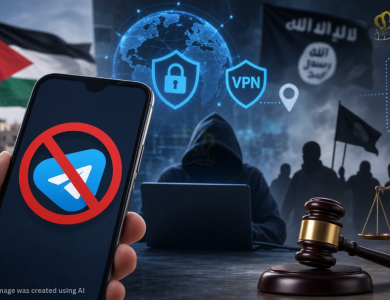


A group comprising more than 12,000 members circulated materials for manufacturing explosives .. An expert reveals to “Al-Taj” the details of blocking Telegram in Jordan
Al-Taj News – Haneen Zubeideh
Cybersecurity expert Engineer Ahmed Al-Sarayrah said that the danger of the “Telegram” application does not lie in its technical structure alone, nor in the extremist groups that exploit it by themselves, but rather in the intersection between the technical features provided by the application and the ability of those groups to employ and adapt them to serve their goals, whether in recruitment, spreading extremist content, or exchanging prohibited information and materials.
Al-Sarayrah explained in statements to “Al-Taj News” that the Telegram application combines a set of features that make it an environment exploitable by extremist groups, most notably public broadcast channels that place no limits on the number of followers, and closed groups that can include tens of thousands, alongside encrypted secret chats that allow features for self-destructing content.
He pointed out that the application also allows the use of automated bots that can be employed to republish content or restore it after its deletion, which hinders operations to remove violating materials through traditional methods, in addition to the limited proactive censorship of content compared to other platforms such as YouTube and “Meta” company applications.
From open platforms to closed groups.. How do extremist groups lure individuals?
Al-Sarayrah indicated to “Al-Taj” that the danger of exploiting these features is manifested in the ability of extremist groups to use open platforms, such as “TikTok,” “X,” and electronic games, to attract individuals and influence them gradually, by targeting their interests and points of vulnerability, whether emotional, religious, or linked to the games and content they follow.
He added that these groups work to move targeted individuals gradually from open platforms to closed channels and groups, with the aim of isolating them from their previous digital surroundings and subjecting them to a more closed intellectual environment, allowing them to influence their orientations and attract them in a progressive manner.
He noted that the Telegram application can turn into what he described as “integrated operations rooms” used by extremist and terrorist groups, which include recruitment activities, gradual attraction of individuals, and exchanging materials and manuals that deal with manufacturing explosives.
Al-Sarayrah revealed to “Al-Taj” that a group on the application whose number of members exceeded 12,000 circulated materials related to mechanisms for making explosives, considering that this is one of the main reasons for banning the application in Jordan, and affirming the rejection of such practices, especially in light of Jordanian efforts in combating extremism and terrorism.
He explained that the materials being circulated inside these groups may be used in preparing to launch attacks or attracting what are known as “lone wolves,” and providing materials that help in individual training and carrying out terrorist activities without the need for a group on the ground.
He pointed out that extremist groups also exploit cryptocurrencies in financing their activities and operations, including financing individuals who are attracted and directed via digital platforms.
Blocking Telegram.. A disruptive blow that does not dismantle the digital structure of extremism
In his assessment of the decision to block the application, Al-Sarayrah described the step as a “tactical disruptive blow,” explaining that it cuts off the easy link of communication between users and the platform, but it does not on its own lead to dismantling the digital structure in which extremist groups operate.
He indicated that the use of Virtual Private Networks (VPN) and other means of bypassing blocking allows users to access banned applications, noting that tracking these means represents a technical and financial challenge, given their multiplicity and the difficulty of confining them to a single company, server, or protocol address.
During his interview with “Al-Taj,” Al-Sarayrah warned of the dangers of what he described as “digital migration,” given that extremist groups possess high flexibility in moving between applications and platforms, as a result of their reliance on decentralized methods of operation, pointing to the existence of activities for these groups on alternative platforms such as “Signal,” “Session,” and “Matrix,” in addition to the Dark Web.
He added that the transfer of these activities to more complex platforms may make monitoring, penetrating, and tracking them more difficult, which requires expanding security and technical follow-up tools and not settling for the blocking decision alone.
Cyber intelligence and drying up financing.. Tools that must accompany the blocking decision
Regarding the measures that should accompany the blocking decision, Al-Sarayrah identified a set of tools, foremost among them developing cyber intelligence capabilities and utilizing artificial intelligence in monitoring camouflaged links, symbols, and linguistic codes used by organizations to direct their followers toward alternative platforms.
He also called for strengthening cooperation with international technology companies and pressuring them to oblige them to cooperate in removing cross-border terrorist content from their platforms, similar to the procedures followed by other technology companies and platforms.
In his interview with “Al-Taj,” Al-Sarayrah stressed the importance of drying up sources of digital financing, by tracking electronic wallets, especially those linked to cryptocurrencies, which may be used to finance cells and individuals who are attracted via applications and digital platforms.
He added that dealing with digital circumvention tools, including Virtual Private Networks and means used to bypass blocking decisions, represents another aspect of the measures that should be worked on in parallel with the decision to ban the application.
Penalties alone are not enough.. Intellectual and social motives reproduce extremism
Regarding tightening security measures and penalties against those convicted in terrorism cases, Al-Sarayrah believed that settling for security prosecutions and penalties without dismantling paths of intellectual mobilization may push extremist groups to move to other platforms and applications, without addressing the environment that allows their activity to continue.
He explained that blocking addresses the means used by these groups, which is the application or platform, but it does not address the intellectual and social motives that may push individuals toward extremism, among which are hardline ideology, a feeling of marginalization, cognitive emptiness, and social crises.
He pointed out that extremist groups work continuously to innovate new methods for camouflage and reaching youth, through satirical symbols, digital content, electronic games, and even content produced using artificial intelligence, which makes closing a platform or application insufficient to end their activity.
Al-Sarayrah confirmed to “Al-Taj” that confronting this phenomenon requires developing a counter media and intellectual discourse, capable of dealing with extremist narratives in a language close to youth, and understanding their interests and the motives that may make them vulnerable to attraction, alongside promoting digital literacy and training them in critical thinking and uncovering methods of emotional luring and intellectual influence.
He noted that what he described as “digital illiteracy” is not limited to the elderly or groups that have not kept pace with technological development, but extends to segments of youth who lack sufficient awareness of how to use technology and deal with digital content, which calls for working to raise the level of awareness and digital capabilities among them.
Al-Sarayrah concluded his interview with “Al-Taj” by emphasizing that the radical treatment of extremism requires, alongside security and technical measures, renewing religious and cultural discourse, and addressing economic and social gaps, especially those related to poverty, unemployment, and marginalization among youth, warning that the continuation of these conditions may make some groups more vulnerable to attraction by extremist groups.