
Hassan Reviews Government Achievements Before MPs: Three Budgets, Strategic Projects, and Positive Growth Indicators
Al-Taj News – Prime Minister Jaafar Hassan affirmed that the government began its work from the moment it was formed by relying on the three modernization tracks: political, economic, and administrative, considering them a project for the future of the Jordanian state and not merely a government project. He stressed the continuation of work to achieve accomplishments and strengthen development paths.
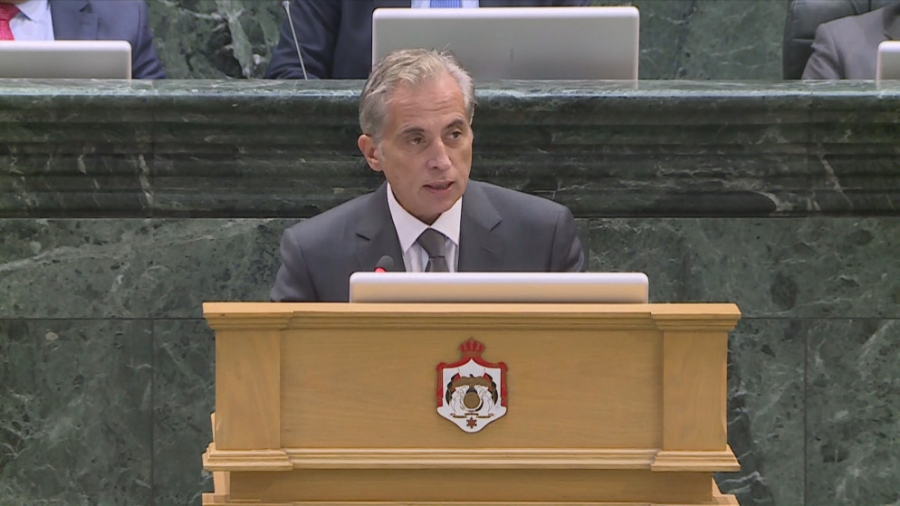
During a speech delivered before the House of Representatives on Monday, two years after his government submitted its ministerial statement, Hassan said that the political track in which the government believes is based on strengthening national dialogue around priorities, and ensuring that it is frank and honest dialogue that goes beyond escalating disagreements and does not settle for palliative solutions to address challenges.
He added: “We accept differences, but work toward agreement, based on information, facts, and realism, while giving precedence to wisdom and responsibility in our work and discussions.”
He pointed out that two years ago he stood before the House of Representatives to deliver the ministerial statement on the basis of which the government won the confidence of a majority of the House, affirming that he stressed at the time the directives of His Majesty King Abdullah II that belonging to Jordan is based on sincerity, seriousness, responsibility, initiative, and perseverance.
Hassan affirmed that national work is measured by achievement and the impact realized in communities, and that being present with citizens in their various locations represents a path to strengthening trust and identifying priorities, noting that public service is a duty, service, effort, patience, and determination.
He explained that the General Budget Law reflects the government’s policies and priorities in dealing with financial, service-related, development, and security challenges, noting that the government is presenting its third budget during its tenure before the House of Representatives, at a time when the House is halfway through its term.
He stressed the importance of clarifying what the government has achieved over the past two years, what it has committed to, and what it is working to achieve or complete during the coming year, affirming his responsibility for implementing the commitments the government presented before the House.
Economy, Growth, and Investment
Hassan said that the government placed the economy at the forefront of its priorities and worked to strengthen its resilience, expand its capacity for growth and production, and consolidate self-reliance, despite exceptional circumstances, regional turmoil, and their economic repercussions.
He explained that, despite the rise in energy and transport costs, the government maintained price stability as much as possible and kept inflation at moderate levels, reaching 2.32% during the first ten months of the current year, one of the lowest rates in the countries of the region.
He pointed to an increase in foreign direct investment inflows during 2025 by 25.1%, exceeding two billion dollars and recording their highest level in the past decade. He expected investment growth to accelerate during the coming years thanks to the strategic projects launched by the government, most of which are foreign investments.
He stated that the real growth rate increased during the second quarter of the current year by 3%, supported by the strong performance of productive sectors and exports. He expressed his expectations that positive growth would continue during the coming year, supported by assessments from global financial institutions.
He added that total exports grew by 11.2% during the first eight months of the current year, while foreign reserves at the Central Bank recorded record figures, affirming that these indicators reflect the national economy’s ability to grow, remain resilient, and face challenges.
Strategic Projects in Water, Transport, and Energy
Hassan affirmed that the government had begun implementing major strategic projects in the water, transport, and energy sectors, which Jordanians had awaited for many years, moving them from the stages of studies, planning, and preparation to actual implementation, while allocating the necessary funds in partnership with the local and foreign private sectors.
He pointed to the laying of the foundation stone for the National Water Carrier Project, which he described as the largest strategic project in the Kingdom’s history and one of the largest water desalination and transportation projects at the regional and global levels, with a total cost reaching 6.6 billion dollars.
He added that last month the government laid the foundation stone for the Aqaba–Shidiya–Ma’an railway project, with a total cost of 2.5 billion dollars and an equal partnership between Jordan and the United Arab Emirates.
He noted that the government is currently working to complete the necessary studies for establishing the Aqaba–Ma’an dry port project, to serve as a logistics, development, and industrial center linked to the railway project, based on a unified development vision for Aqaba and Ma’an.
In the energy sector, Hassan said that the government had begun developing the Risha Gas Field and working on the stages of constructing the gas pipeline that will connect the field to the Arab Gas Pipeline, extending to electricity generation stations and industrial and development areas, in a way that contributes to reducing costs, strengthening energy security, and meeting the needs of the electricity sector.
He expected the companies that will be awarded the contract to implement the gas pipeline to be selected during April 2027.
He affirmed that major projects are not limited to investment in infrastructure, but represent an investment in Jordan’s future and its water and energy security, enhancing the competitiveness of the economy and industries, stimulating economic sectors, and expanding employment opportunities for Jordanians.
He added that during the coming months, the government will begin issuing tenders for the implementation of projects in the first phase of Amra City, with various essential components.
He explained that financing these projects depends on contributions from the budget and investment incentives, in addition to attracting investments and partnering with the private sector, allowing capital expenditure to be directed toward service projects in the education, health, transport, water, and other sectors.
Industry, Agriculture, and Tourism
Hassan pointed out that the Jordanian-European Investment Conference, which was recently held at the Dead Sea under royal patronage, and the agreements and understandings resulting from it to strengthen the partnership with Jordan’s friends in Europe and around the world, reflected international confidence in Jordan’s investment environment and the standing of the Kingdom and its leadership.
With regard to industry, he said that the government had completed the establishment and inauguration of natural gas supply stations for industries in southern Aqaba, Qweira, Qastal, and Hashemiyah, with the aim of reducing energy costs for industries by rates ranging between 35% and 60%.
He added that work had begun on establishing two new stations in Al-Rawdah Industrial City in Ma’an and another in Al-Muwaqqar, which are scheduled to be completed during the coming year.
He pointed out that new incentives had been introduced to attract investments to the industrial cities in Karak, Tafileh, Ma’an, Salt, and Madaba, through reducing land prices and energy costs, with the aim of expanding investment and supporting the employment of Jordanian workers.
He stated that, following the approval of these incentives, the industrial cities in Karak, Tafileh, and Ma’an attracted 34 new companies, with an investment volume exceeding 62 million dinars, and they are expected to provide more than 1,000 job opportunities for residents of these governorates.
He noted that the Industrial Support Fund provided support to 635 companies to strengthen their competitiveness, while 771 companies benefited from the export support component to expand their markets. These companies contributed to providing employment opportunities for young people.
In the agricultural sector, Hassan said that the government had inaugurated eight food-processing factories over two years and increased the sector’s contribution to gross domestic product by approximately 160 million dinars within one year.
He added that the government had amended the Cooperatives Law to support and empower small and medium-sized productive projects and provide employment opportunities in agricultural fields. It is also working to organize the first international exhibition and conference in Jordan for irrigation and agricultural technologies, with the aim of attracting investment and developing the sector.
As for the tourism sector, he explained that its contribution to gross domestic product had risen to 12.6% during 2025, despite the challenges, regional crises, and conditions of war.
He pointed to the provision of incentives, exemptions, and facilities for tourism establishments and activities in the most affected areas, including Petra, to preserve the sector’s sustainability and the job opportunities it provides. This is in addition to continuing support for low-cost aviation, charter flights, and Royal Jordanian Airlines, and expanding the organization of activities and events at tourist sites to attract domestic and foreign tourism.
He added that the government is working to develop tourist destinations in the governorates, including the environmental tourist village in Jerash, which will be inaugurated next summer, and the Azraq Eco-Tourism Oasis, scheduled to open next April.
The government is also working to develop Afra Hot Springs in Tafileh, with the project expected to be completed by the end of next year, in addition to projects in the Dead Sea area and the development of archaeological sites in various governorates.
Debt, the Budget, and Political Modernization
Hassan said that the government was keen to submit the budget proposal early, allowing capital and development projects to begin implementation at the start of the year without delay. He affirmed that its responsibility does not end with the approval of the budget, but extends to ensuring its proper implementation and adherence to its timetables.
He pointed out that the government is working to address the debt burden, which has worsened over the past 15 years, by expanding the economy, increasing growth, gradually reducing deficit rates, cutting current expenditures, raising productivity, and lowering debt-servicing costs.
He added that since its formation, the government had paid 1.3 billion dinars in arrears inherited from previous years, which had not been included in the debt figures, explaining that these amounts benefited various economic sectors.
Regarding the political modernization track, Hassan affirmed the government’s commitment to continuing the implementation of the outcomes of the Royal Committee for Modernizing the Political System, in cooperation with the House of Representatives, and maintaining communication, dialogue, and consultation with parliamentary party blocs.
He said that over the past two years, the government had held a continuous series of meetings and adopted decisions and policies based on parliamentary and party observations, affirming that this approach would continue.
He added that the government looks forward to benefiting from the national expertise and capabilities found within political parties and building on the development taking place in the party movement, including the expanded representation of women and young people, and translating this presence into effective participation in party work and decision-making, as well as clear programs that respond to citizens’ needs.
Local Administration and Municipal Services
Hassan said that the government had completed the Local Administration Law in coordination with the House of Representatives, along with the relevant legislation, in preparation for holding municipal elections scheduled for April 27 next year.
He explained that the government had focused on strengthening governance in municipal work, ensuring accountability and oversight, and enabling municipalities to perform a development and investment role that stimulates the local economy.
He pointed to efforts to raise the percentage of women’s representation on municipal councils to no less than 30%, and to strengthen the participation of young people, persons with disabilities, and local communities in identifying development priorities and local decision-making.
He affirmed that completing the modernization tracks requires an efficient public administration capable of keeping pace with the requirements of the current stage, improving the performance of government institutions and the quality of services, and consolidating the principles of merit, efficiency, transparency, and accountability.
Salary Increases and Social Protection
Hassan affirmed that MPs’ observations and demands had a clear impact on government decisions, noting that MPs reflect citizens’ needs and aspirations, and that the government is keen to meet those that are possible.
He explained that the decision to increase the salaries of civilian and military employees and retirees by 30 dinars for those whose salaries are below 600 dinars, effective from next year, came during discussions of the General Budget Law last year.
He pointed out that this comes alongside the decision to raise the minimum wage from 260 to 290 dinars in 2025, affirming that these decisions came in response to parliamentary demands and were discussed during government meetings with parliamentary party blocs.
Within the framework of social protection, Hassan said that the government had expanded the coverage of beneficiaries of the National Aid Fund’s programs by including 15,000 new families, bringing the total number of beneficiary families to approximately 250,000.
He added that the government had doubled the allocations of the University Student Support Fund to 40 million dinars, after they had stood at 20 million dinars two years ago, raising the number of beneficiary students to approximately 63,000 male and female students.
He pointed to the full repayment of the University Student Support Fund’s debt to public universities, amounting to 80 million dinars, allowing the universities to raise their performance levels.
Health and Education
In the health sector, Hassan said that one year ago the government launched an insurance program at King Hussein Cancer Center at a cost of 124 million dinars, covering more than 4.2 million citizens. He noted that the program’s expansion would continue to include an additional 300,000 insured citizens starting next year.
He added that the Sameeh Darwazah Center for Cancer Patients at Al-Bashir Hospital would be expanded, a cancer center would be established at Princess Basma Hospital in Irbid, and another center would be established in Karak next year.
He pointed to the inauguration of Princess Basma Hospital in Irbid, with a capacity of more than 500 beds, and the Digital Health Center in Salt, the “Virtual Hospital,” as well as the completion of the first phase of the expansion of Princess Iman Hospital in Ma’addi, while work on the second phase continues.
Work is also underway on the new expansion project at Ma’an Hospital, which includes the outpatient clinics building and the blood bank, in addition to the start of the expansion of Prince Faisal Hospital in Zarqa through the construction of a new building.
He stated that the government had completed the first phase of the new Madaba Hospital project, which is being implemented in partnership with the private sector for the first time, in addition to rehabilitating new outpatient clinics at Karak Hospital.
In the education sector, Hassan said that the government had completed 252 school construction projects over two years in all governorates of the Kingdom, including 120 new model schools and 132 projects to add classroom buildings to existing schools.
He added that these projects fall within the 500 projects the government pledged to implement in its ministerial statement over five years, noting that approximately 300 school construction projects will be completed during the coming years, including 183 new schools and 115 projects to add classroom buildings.
He pointed to the launch of the “Siraj” and “Ajyal” platforms, through an initiative by the Future Technology Council, to develop the education system by employing artificial intelligence and digital technologies, improving learning outcomes, and empowering teachers and students.
He explained that the two platforms include more than 2.26 million male and female students and 146,000 male and female teachers, while the number of users of the “Siraj” platform reached approximately 1.3 million.
He noted the launch of the free school transportation project for the first time and the beginning of its implementation in areas of the southern Badia, where 9,000 male and female students and 900 male and female teachers benefited from its first phase.
He added that the project will expand at the beginning of the new school semester in February next year to include new areas in the southern and central Badia, while efforts are being made to reach 30,000 male and female students during the coming year.
Transport and Judicial Development
In the transport sector, Hassan affirmed that public transport represents a priority for the government, pointing to the launch of the regular inter-governorate transport project, which contributed to facilitating citizens’ use of public transport through regular schedules and reduced waiting times.
He said that the government had expanded the routes and services of the Bus Rapid Transit within the capital, Amman, with the cumulative number of its users exceeding 78 million passengers since operations began.
He added that one year ago the government began expanding Bus Rapid Transit services from Amman to Salt and Madaba, with more than 600,000 passengers using the Amman–Madaba route and more than 460,000 passengers using the Amman–Salt route during this period. He affirmed that plans to develop public transport in all governorates would continue over the next two years.
Regarding judicial development, Hassan said that the government had cooperated with the House of Representatives in amending important legislation, including the Penal Code, the Code of Criminal Procedure, and the Enforcement Law.
He explained that these amendments aim to develop, simplify, and accelerate litigation procedures, digitize services within courts, expand community-based penalties, and activate restorative justice in minor cases.