
When Children Pay the Price for Parents’ Extremism .. Who Will Save Them from the Legacy of Takfir?
Al-Taj News – By Ruba Al-Dghaimin
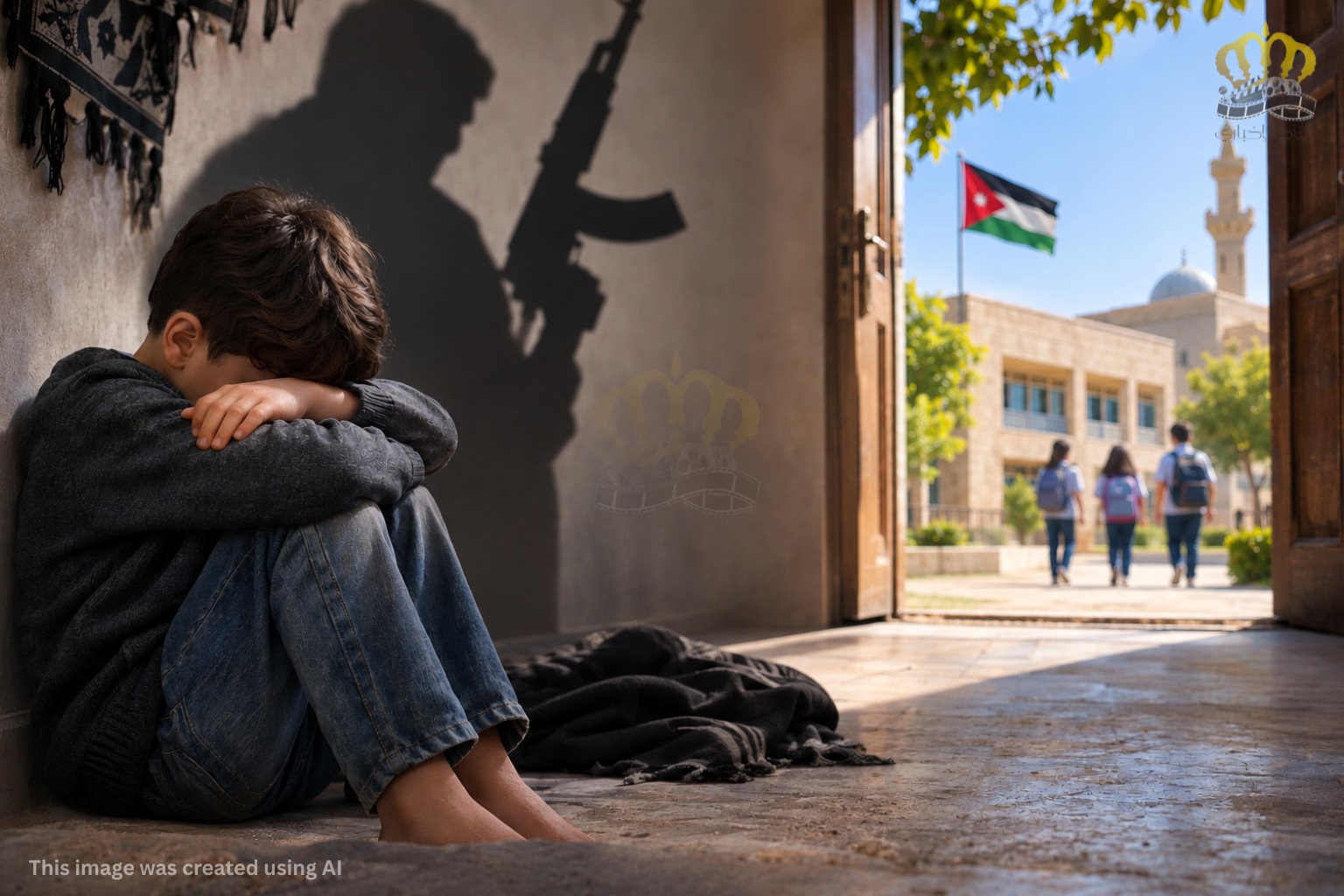
The repercussions of extremist thought do not stop at its perpetrators, but may extend to their children, who find themselves in an environment saturated with deviant ideas, through no fault of their own regarding their parents’ choices or orientations, raising questions about the future of these children, the extent to which their psychological and intellectual development is affected by what they were raised on, and the authorities responsible for protecting them from turning into an extension of this ideology.
In this context, social expert Hassan Al-Sabarini stated that so-called Takfiri thought cannot be considered a thought in the true sense, but is rather deviation, ignorance, and absurdity, emphasizing that attacking human life contradicts the essence of the Islamic religion, which is based on mercy, tolerance, and preserving human dignity.
Extremism Knows No Educational Boundaries
Al-Sabarini added during his talk to “Al-Taj News” that intellectual deviation is not linked to the level of education or academic achievement, as a person may hold advanced scientific degrees and be a doctor, engineer, or university professor, but on the other hand suffer from a flaw in their intellectual and religious understanding, as a result of receiving Sharia knowledge from non-specialists or following anomalous views and incorrect interpretations of religious texts.
From Family to School.. Responsibility Beyond Awareness
He stressed that confronting these ideas is not limited to the security aspect, but requires an integrated awareness and educational role, starting from the family, school, and university, and not ending at the mosque and media outlets, pointing to the importance of referring to specialists, Sharia scholars, and relevant institutions, headed by the General Iftaa Department and the Ministry of Awqaf, to present the correct, moderate understanding of religion.
Early Dialogue to Confront Deviant Ideas
Regarding ways to prevent the transmission of extremist ideas to children, Al-Sabarini confirmed the necessity of early intervention through dialogue and guidance sessions, and providing correct religious explanations, especially when noticing the emergence of deviant ideas in an individual, noting that dealing with these cases must combine awareness, guidance, and rehabilitation.
Psychological and Social Rehabilitation.. The Path of Prevention and Treatment
He pointed to the importance of taking into account the psychological aspect when dealing with these cases, as some psychological disorders or cases of suppression might be among the factors that warrant study and understanding, making psychological intervention an important part of the rehabilitation process, alongside the educational and social role.
He confirmed that the responsibility for confronting extremism is an integrative responsibility in which awareness, educational, psychological, and security roles overlap, in a way that ensures the prevention of the spread of extremist ideas, addressing their effects, and protecting individuals and society from their repercussions.
Al-Sabarini concluded his talk to “Al-Taj” by emphasizing that rehabilitation represents a necessity in dealing with these cases, and that building proper awareness and promoting the values of mercy and tolerance constitute a fundamental pillar in immunizing society against deviant thought.